Showing posts with label Challenge. Show all posts

9 November 2014

A logical puzzle

A logician visits a distant planet inhabited by two groups of aliens, compulsive liars and faithful truth-tellers. 

She comes to a fork in a road - one road goes to the left, the other to the right. She meets two aliens there, one a liar, the other a truth-teller... but she doesn't know which is which. 

The logician must ask just one Yes/No question to discover which road she should take to reach their leader. She thinks for a moment and then asks her question. 

What question might she have asked?

Post your theories and ideas as comments to this post...
2 November 2014

Using scale

This session will introduce you to a number of concepts relating to scale. The learning you've recently done on fractions and multiplication will help you. 

For some of these problems you should work with others to solve them so you can discuss the issue. You might find drawing examples on the whiteboard or in your maths books helpful also.

Scale is a practical way to represent something that is large using correct proportions. For example, if you wanted to draw a plan for a swimming pool or a house, you'd obviously not want to draw it using a scale of 1:1, as this would be impractical! You need to represent it on a piece of paper (or the computer) in a way that is manageable. This is what scale is used for...

Example - using a scale of 1:20 for the swimming pool...
Notice that the first number (i.e. 1) always refers to the length of the drawing on paper and the second number (i.e. 20) refers to the length of real-life object.

To read it, think of the " : " as meaning "is to".

Problems to solve:

    van-image
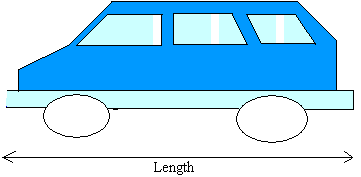
    Suppose a problem tells you that the length of a vehicle is drawn to scale. The scale of the drawing is 1:20. Tree-image


1. If the length of the drawing of the vehicle on paper is 12 centimetres, how long is the vehicle in real life?      


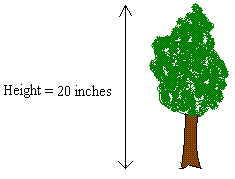
2. The scale drawing of this tree is 1:500. If the height of the tree on paper is 20 centimetres, what is the height of the tree in real life?

3. The distance between two towns measures 6cm on a map. What is the true distance if the scale is 1 : 50 000. Provide the answer in kilometres.

4. This next example is the opposite working of #3 above; this time we are looking at the measurement on the map as we have been given the actual distance. 

5. The drawing of an Aircraft uses a scale of 1 : 900. If the Aircrafts wingspan is 30m what length on the drawing actually represents this?
    Extra for experts:
    The plans of a house show a room to be 4.0m X 3.6m. The dimensions of the room on the plans measure 20mm X 18mm.

    What was the scale used? Explain how you worked this out...

    Understanding scale...

23 October 2014

Expanding circles problem

Imagine heating a metal ring enough so it expands. What happens to the hole, does it get bigger or smaller?
metal ring

Perimeter problem 4

Your house is 24m long and 16m wide. You decide to plant shrubs around the house to protect the exterior walls from direct sunlight. Starting with a shrub on one corner of the house, shrubs will be planted 1m apart around house and 1/2m out from the house. How many shrubs will you need to surround the house?

Angles - cube problem

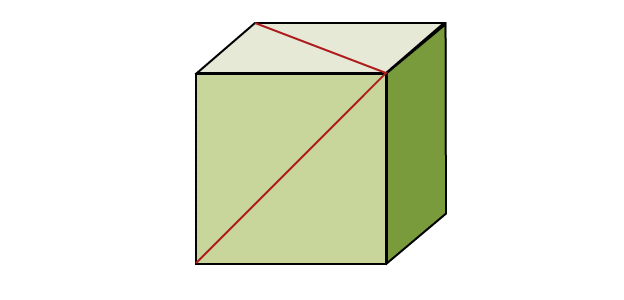
1. What angle is made by the two red lines drawn on the two sides of the cube, as shown in the illustration?
cube 1

Answer...
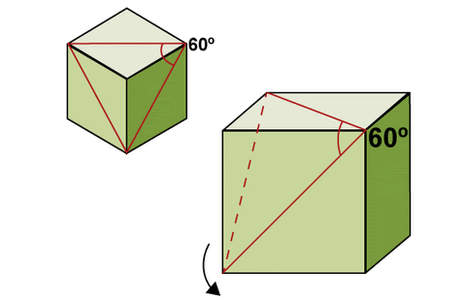
If the ends of the two red lines at the bottom left and top left are connected by a third red line along the invisible left face of the cube, then since each of the red lines joins two opposite corners of same-sizes squares, those three lines form an equilateral triangle. Hence at each corner of that triangle, two red lines meet at 60 degrees.
cubes 2

Perimeter problem 3

Matt has a set of 20 cards. Each card is 10cm long and 5cm wide. Matt has decided to protect the edges of the cards with tape. He carefully makes sure the tape covers all the edges by taking the tape to each corner. How much tape is he going to need to bind all the cards?

Perimeter problem 2

Mrs Chickory has 24m of wire netting to make a rectangular enclosure for her chickens. If the length of each side is a whole number of metres, describe all the different rectangular shapes she could make with this piece of netting.


Perimeter Problem 1

A square garden has a side length of 22 metres. How many metres of fence are needed to enclose the garden?


11 September 2014

Maths challenge - The Football Stadium

Here's a goodie...
The football stadium is filled with 7800 fans, which leaves two fifths of the available seats empty. How many seats does the stadium have?

Show your working and explain it...

24 July 2014

Crime Scene Investigators

Video from the science investigation today - what are the 3 gases and which one is potentially harmful to the ecology of the earth? What are the 'terrorists' trying to achieve???

movie coming soon...


20 July 2014

Web Challenge - altering the blog slider

Here is a little challenge if you wish to get into a bit of HTML coding - change the slider images on the class blog...
  1. Find an image of something that happened in the class that you think would make an interesting highlight for the blog.
  2. Resize the image - if using Apple Preview follow these instructions... if using windows do a web search to figure it out. The images need to be 960x400 pixels max.
  3. Download a free text editor (e.g. TextWrangler or similar) and then copy the HTML code from inside the blog Template > Edit HTML, making sure you select all then copy it into a new text document to save onto your computer.
  4. Scroll to line 1537 to spot the code you need to change.
  5. Upload the resized images to a new album inside your Google Plus. Navigate to the image you wish to use, then right-click and copy image URL.
  6. Paste the URL in so that it replaces the old URL of one of the slider images. Then ensure you copy the URL for the post the image will link to. 
  7. Don't forget to give it a Title, Description and delete the links that are placeholders.
Google Plus your masterpiece to the class to show them!

8 June 2014

Maths Challenge - Throwing A Dice


5 June 2014

Heat Transfer Investigation

Today in Science the challenge is to identify the best insulator and the best conductors from a range of items, using this investigation process...

Here are some shots of the challenge in action...


Questions for students to reflect on (and record ideas to in the comments below...):

  1. What is the difference between an insulator and a conductor?
  2. How might you improve the investigation?
  3. Why do you think scientists sometimes investigate the same issue using a range of different approaches and methods?
  4. Anything else you can think of... ;-)

29 May 2014

Investigating a mystery substance

As part 2 of our investigation into various substances, today we spent time investigating mystery substances found on a 'crime scene'. This involved the class using the diagnostic tests they conducted last week to collaborate and deduce what the mystery substance was. Here are some photos of them working:


25 May 2014

Triangle Exploration

Use this page below to explore and list down in your maths journal (or as a comment on this post) as many different types of triangle as possible!

During this session, students should explore two concepts relating the classification of triangles - by shape and by angle.

Further reading on classification of triangles here...

23 May 2014

Science - testing various solutions

Today we conducted a number of diagnostic tests on everyday solutions. These tests were: melting, solubility, acid, acidity. This experiment is part 1 of a 2 part series.

Here is a movie of Jenny conducting the acid reaction, using vinegar:


17 April 2014

Archimedes' Principle

Today in science the students were given their first science challenge - to explore Achimedes' Principle. the good thing about this experiment is that it can be conducted in a wide variety of ways and it can be done in many places - at home for example.

Science Challenge - Archimedes' Principle
Design an experiment to investigate and show Archimedes’ Principle. This will involve you showing what you’ve learned about the scientific process so far.

The Challenge:
Show how much mass an object has and measure it using correct units. Illustrate the science behind this.

Process:
  1. Find out what Archimedes’ Principle is…
  2. Decide on the process you will use, writing this up in a Google Doc. You may do a draft in your Science book if you wish.
  3. Share this document in the Science folder inside Totara Shared Folder, naming it as follows: Science Challenge 1 - Rob Clarke 10 April 2014
  4. Conduct your experiment next week, ensuring you have your data table ready to go.
  5. Write the experiment up, along with hypothesis, method and results.

This is the movie we viewed to help with our research and formation of the first experiment:

Vocabulary explored: bouyancy, floatation, principle, perplex, mass, density, displaced, immersed, eureka, 

3 April 2014

Science Investigation - Water Boiling Experiment

During the last two weeks we've been practising our practical science skills and measuring/recording the rate at which water boils. Click the tabs at the bottom of this embedded spreadsheet to view each students' data table and resulting graph.

Today the students were introduced to using a spreadsheet for graphing their results. Next steps are figuring out how to graph accurately, as well as why results are different and link this to the scientific process.

1 April 2014

Divisibility Investigation


  • Find a way of telling if a number is divisible by 3. Hint: Add up the digits.
  • Find a way of telling if a number is divisible by 4. Hint: Look at the last two digits
  • Find a way of telling if a number is divisible by 6.
  • Find a way of telling if a number is divisible by 8. Hint: Look at the last 3 digits.
  • Find a way of telling if a number is divisible by 9.
  • Find a way of telling if a number is divisible by 11. Hint: Pair up the digits from the right. Add the numbers made together.

27 March 2014

The Stairs Problem


How many steps will he run on the super stairs? How long will it take him to run them?

Write down an estimate and share it with your classmates. 
  1. What information would you need to solve this problem?
  2. Write down your thoughts as comments to this blog post.
  3. Extra for Experts: If someone wanted to run 1,000,000 steps, what kind of super staircase would that require?
Put your thoughts as comments to this post - post anonymously but please put your name to your ideas.